AI is already finding its way into the tools and workflows responsible investors use to assess companies, understand risk and identify opportunities.
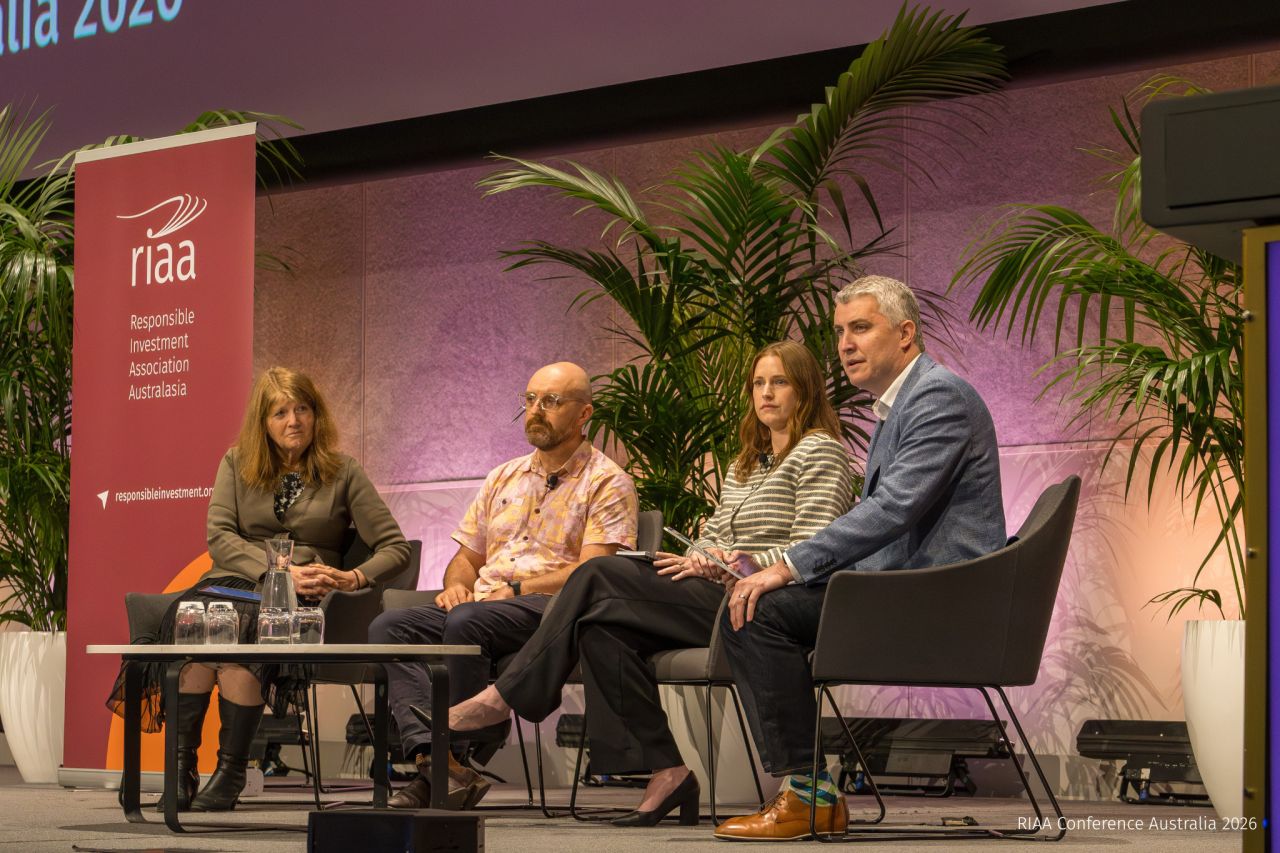
At the RIAA Conference Australia 2026, Harvey’s Simon Smallchua joined Jeremy Hubbard (RIAA Board Member & Chief Technology and Data Officer at Rest), Colleen Raab Smith (Portfolio Manager and Lead Strategist for Sustainable Solutions at Los Angeles Capital Management) and Sue Brake (Chair of Dragonfly Thinking, ex CIO of the Future Fund) for a panel on AI for responsible investors. The conversation moved quickly past broad hype and into the practical reality of using AI: where it is genuinely useful, where it remains unreliable, and what investors need to understand before trusting it.
From chatbots to agents
A key theme of the panel was the shift from AI as something you “chat with” to AI as something that can act.
Jeremy Hubbard framed this as a move from talking to AI, to a world where AI acts. Instead of people simply sitting down to work on computers, we may be moving towards a world where computers are increasingly working for people.
That shift matters. AI agents can search, summarise, write, code, analyse and, increasingly, take action across systems. For investment teams, that opens up significant opportunities, from faster research and scenario analysis to deeper ESG assessments and more scalable portfolio insights.
But it also introduces a different kind of risk.
As Simon put it, many AI tools are highly action-oriented. They are designed to keep moving forward, even when they are wrong.
“One of the key things that is a common trait of these chat agents is that they’re sycophantic. They’re highly biased towards yes, do, yes, move forward, create something.”
For responsible investors, that creates a clear challenge: AI can help process complexity, but it cannot be taken at face value.
Practical use cases are emerging
The panel shared a number of practical examples of AI already being used in investment contexts.
Colleen described how Los Angeles Capital has used AI techniques over several years, starting with natural language processing across unstructured company information such as company reports, earnings call transcripts, news events and regulatory filings. From there, the work has expanded into clustering techniques, machine learning and large language models to help identify sustainability themes, exposure to climate technologies, regenerative companies and potential future green revenue growth.
Sue shared an example of a “beliefs agent” she built to help interpret investment beliefs, draw out implicit beliefs from public statements and reports, review vetted academic research, and explore what different beliefs might mean for portfolio construction.
Simon shared a smaller pilot Harvey ran around responsible investment assessment questions. The goal was to test whether AI could find and verify relevant information online.
The results were mixed.
“There was about a 60% accuracy rate on the information, even though it was very confident that it was right.”
Even more concerning, some answers included references that looked legitimate but did not exist.
“It would say, yes, I found the information. This company has this percentage, blah. Here’s the link to go find it from a well-known reputable company. And the link doesn’t exist on that website.”
For investors, this is one of the most important lessons: AI can sound right while being wrong. Confidence is not the same as accuracy.
Harnesses, human oversight and critical review
One of the strongest themes from Simon’s contribution was the need for what he described as a “harness”.
In simple terms, a harness is a structured framework around an AI tool that forces it to check, critique, cross-reference and validate its own work before producing an answer.
“There’s a much bigger need we’ve realised with both programming and things like RI to create what’s called a harness, which is a whole framework for it self-assessing itself and critiquing and cross-checking many times before it gives you an answer.”
This moves AI from a simple chat interface into something more robust. But even with a harness, Simon was clear that human oversight remains essential.
The reason is simple: AI can create more work, not less, if the review process is not designed well.
“When I do have 10 agents running at the moment on a code base, it creates 10 times the review work for me. You can’t just trust it. You have to go and double check it.”
That point is especially relevant for responsible investment teams. AI may speed up research and analysis, but it also increases the burden of governance, verification and accountability.
The governance question for investors
The panel also explored what investors should be asking of the companies they invest in.
Colleen outlined a practical starting point: what is the company actually doing with AI, and who is responsible for the outcomes?
That includes questions around board oversight, executive accountability, AI policies and procedures, deployment frameworks, bias testing, model drift monitoring, cybersecurity, data privacy and transparency.
Her point was clear: having an AI policy is no longer enough. It is “the floor today, not the ceiling”.
For responsible investors, this creates another area of due diligence. AI is becoming both an investment opportunity and a governance, environmental and social risk factor.
Companies need to be able to explain what they are using AI for, what risks are involved, and how they would intervene if something went wrong.
The risk of cognitive outsourcing
Not all risks are technical. One of the more interesting themes was the risk of “cognitive outsourcing”.
Sue named this as one of the risks she is most concerned about: the temptation to let AI do too much of the thinking.
Simon built on this from a practical perspective.
“If you use AI to a certain extent, you don’t know how to do your job anymore.”
He shared his own example of using AI to help write code in a programming language he wanted to learn. While the tool helped him produce the work, it did not necessarily help him build the same depth of understanding.
“I’ve been using AI to do it and I haven’t really learnt it.”
For investment teams, this raises an important question: how do you use AI to augment judgment without weakening the human expertise that makes judgment possible?
The panel’s answer was not to reject AI, but to use it consciously. AI should support thinking, not replace it.
What happens to junior roles?
The panel also touched on one of the biggest workforce questions: if AI can produce ESG assessments, research summaries and investment analysis, what happens to junior roles?
Simon’s view was that organisations have a strategic obligation to keep junior people involved, even as their work changes.
“If you play it forward and go, we’re using middle management up to use AI to do what all the young people did, what happens in five or ten years when those people move on or retire?”
The point is not that junior roles will remain unchanged. They almost certainly will not. But if organisations cut off the early-career pathway, they risk creating a future capability gap.
The apprenticeship model may need to change, but the need to train the next generation does not disappear.
The access and equity problem
Simon also raised a related equity concern: the people best placed to benefit from AI may already be the ones with the most access, technical literacy and resources.
“I see it as great for me. I can be ten times better and more capable and more valuable to my clients and to my world, but they can’t even access it yet.”
He pointed to graduates, young people and people without the means to access computers, internet or AI tools as groups that could be disadvantaged if AI capability becomes a requirement for participation in parts of the workforce.
This is a critical issue for responsible investors. AI is not just a technology question. It is also an access, workforce and inequality question.
Use it, but stay critical
The panel was not anti-AI. In fact, there was strong optimism about what AI could make possible for responsible investing, climate solutions, better analysis and more scalable decision-making.
But the optimism came with a clear warning: do not confuse possibility with readiness.
Simon captured the practical stance well:
“I’m all for it, but be critical and be careful and be thoughtful.”
And in his closing comments, he summed up both the opportunity and the caution:
“We’re at the peak of the hype cycle. It’s going to come down, but it’s still gonna be a huge step forward from where we have been.”
For responsible investors, that may be the most useful framing.
AI is not magic. It is not neutral. It is not always accurate. And it is not going away.
The organisations that use it well are likely to be the ones that build literacy, governance and critical thinking into how they use it, rather than treating adoption as the goal in itself.
As Simon put it:
“Practice and play, but be cynical.”
It's an awesome new tool. Humans have fallen for hype like this for over a century. We wont all lose our jobs. It will likely accelerate the economic divide. Read more about Simon's cynical view on AI peak of inflated expectations.






















.avif)



























.avif)